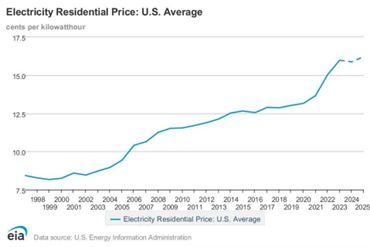
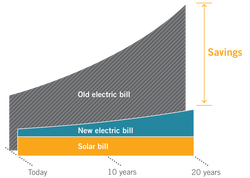
Solar financing isn’t just about whether it works, it’s about whether it works right now under current conditions. The outcome depends on a few key variables that are constantly shifting: interest rates, utility rate escalation, system pricing, and loan structure. Financing solar is essentially a comparison between two paths, a fixed cost for energy through a loan versus a rising cost through the utility. The decision comes down to which path is more favorable over time.
Interest rates directly impact the total cost of solar, with higher rates increasing lifetime payments and lower rates improving returns. At the same time, utility rate escalation works in the opposite direction. As electricity prices rise year after year, the value of locking in a fixed cost increases. These two forces are constantly in tension. Even with higher loan rates, strong utility inflation can still produce a favorable outcome, while low utility growth can make even a well-priced system less compelling.
System price and loan structure often have a larger impact than timing interest rates perfectly. A system priced competitively at around $2.98/W may produce savings, while a higher-priced system can eliminate them entirely. Similarly, loans with artificially low interest rates often include dealer fees that increase the total system cost, reducing long-term value. In many cases, a slightly higher rate with a lower system price results in better overall economics.
The most attractive conditions for financing solar occur when system pricing is disciplined, loan terms are transparent, and utility rates are expected to rise steadily. Less favorable conditions include high system pricing, opaque loan structures, or uncertain utility trends. Waiting for better conditions can make sense in some cases, particularly if interest rates are expected to fall, but waiting also carries risk if utility costs continue increasing in the meantime.
There is no perfect moment to go solar, only moments where the variables align more favorably. The goal is not to predict the market, but to evaluate whether the current combination of rates, pricing, and assumptions produces a result that holds up over time. When those inputs are sound, financing solar becomes a rational financial decision.
Financing Resources to Consider
A lender focused on renewable energy projects, offering solar-specific financing options. They provide a range of loan structures, including lower-rate options that may include dealer fees.
A financing platform designed for solar contractors, offering multiple loan products through a single system. Sunstone provides flexibility in structuring loans, including options with different rates, terms, and fee models.
A regional credit union offering solar loans with a more traditional structure. These loans often have straightforward terms and lower fees, which can result in a lower total system cost over time.