
Tesla Powerwall 3 vs. FranklinWH: Which Home Battery Is Right for Your Home?
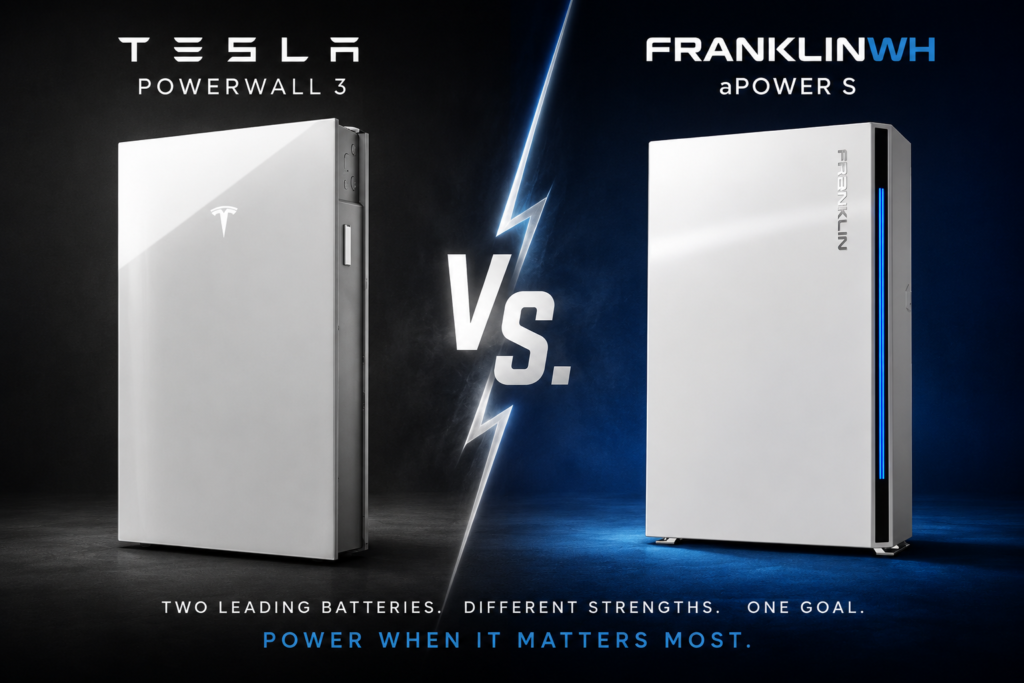
If you’re researching home battery backup, you’ve probably narrowed your search to two of the biggest names in residential energy storage: Tesla Powerwall and FranklinWH.
Both systems allow homeowners to store solar energy, provide backup power during outages, and reduce reliance on the electric grid. Both use safe, long-lasting lithium iron phosphate (LFP) battery chemistry. Both can power much or even all of your home when the power goes out.
So which one is better?
The answer depends less on the battery itself and more on how you plan to use it.
At Cascade Solar, we install both Tesla and FranklinWH systems because each excels in different situations. Some homeowners want the simplicity and value of the Tesla Powerwall 3. Others prioritize whole-home energy management, generator integration, and the flexibility offered by FranklinWH.
Here’s what you should know before making your decision.
Tesla and FranklinWH Take Different Approaches
At first glance, these batteries seem remarkably similar.
Both are designed to work with solar panels, provide seamless backup during outages, and reduce electricity costs by storing excess solar production for use later in the day.
Tesla designed the Powerwall 3 to be a streamlined, all-in-one energy storage solution. It combines the battery and hybrid solar inverter into a single unit, reducing the amount of equipment on the wall while making installation straightforward and efficient.
FranklinWH takes a broader approach. Instead of focusing solely on battery backup, the Franklin ecosystem is designed to manage your home’s entire energy system. Solar, battery, utility power, generators, and even selected appliances all work together under one intelligent platform.
If your goal is simply to add battery backup, Tesla may be all you need. If your goal is maximum resilience during extended outages, FranklinWH offers capabilities that go well beyond battery storage.
Battery Capacity and Power
These batteries are more alike than they are different.
The Tesla Powerwall 3 stores 13.5 kWh of usable energy and delivers 11.5 kW of continuous power.
The FranklinWH aPower S stores 15 kWh of usable energy while delivering 10 kW of continuous power.
In practice, both systems can run refrigerators, lights, electronics, well pumps, HVAC equipment, and many other household loads.
Tesla has a slight advantage in continuous power output, making it better suited for running multiple large appliances simultaneously. Franklin offers about 11% more energy storage, allowing it to power your home slightly longer before needing to recharge.
For most homeowners, neither specification alone should determine the decision.
The Inverter May Matter More Than the Battery
One of the biggest improvements in today’s battery systems is the move toward integrated hybrid inverters.
Both the Tesla Powerwall 3 and FranklinWH aPower S combine the battery and inverter into a single enclosure. This eliminates the need for a separate solar inverter on many new installations, reducing wall space, simplifying installation, and improving efficiency.
This is especially valuable for homeowners with older solar systems.
Many solar arrays installed 10 to 15 years ago still have decades of life left in the panels, but their inverter may be approaching the end of its expected lifespan. Rather than replacing the inverter now and adding a battery later, many homeowners choose to install a hybrid battery system that performs both jobs at once.
Both Tesla and the FranklinWH aPower S make this possible.
FranklinWH's Biggest Advantage
This is where FranklinWH really separates itself.
While Tesla focuses on battery storage, FranklinWH focuses on managing your home’s energy.
The Franklin system intelligently coordinates power flowing between your solar panels, battery, utility service, generator, and selected household loads.
One feature homeowners particularly appreciate is Smart Circuits.
Instead of shutting down your entire backup system when your home’s demand exceeds battery output, Franklin can automatically disconnect non-essential loads like an EV charger or electric water heater while keeping critical appliances running.
The result is longer backup time, greater flexibility, and less need for homeowners to manually manage electrical loads during an outage.
Generator Integration
Power outages don’t always last a few hours.
In some parts of the Pacific Northwest, winter storms can leave neighborhoods without electricity for days.
This is another area where FranklinWH stands out.
Franklin systems can integrate directly with both standby and portable generators. If the batteries become depleted during an extended outage, the generator can automatically recharge them while continuing to power the home.
Tesla Powerwall systems can be used alongside generators in certain configurations, but Franklin’s native generator integration is more comprehensive and requires less compromise.
For homeowners who already own a generator, or plan to install one in the future, FranklinWH is often the more flexible choice.
Existing Solar?
Not every homeowner needs the newest battery.
If you already have solar and your inverter still has years of useful life remaining, replacing perfectly good equipment may not make financial sense.
That’s exactly why Franklin continues to offer the aPower 2.
Unlike the newer aPower S, the aPower 2 works alongside your existing solar inverter instead of replacing it. This makes it an excellent retrofit solution for homeowners who want battery backup while keeping their current solar equipment.
You still gain access to Franklin’s intelligent energy management, generator compatibility, and Smart Circuits without replacing an inverter that’s still performing well.
What About Cost?
Tesla generally has the advantage when it comes to upfront cost.
Its integrated design keeps installation simple and minimizes additional equipment, making it one of the most affordable premium battery systems available.
FranklinWH systems usually require a larger investment, but they also include features that Tesla does not, including advanced energy management, native generator integration, Smart Circuits, and a 15-year warranty.
For homeowners installing a brand-new solar system, the FranklinWH aPower S can also replace the traditional solar inverter, reducing some of the overall equipment costs.
The best value isn’t always the lowest price. It’s the system that best matches your home’s needs over the next 10 to 15 years.
Which Battery Should You Choose?
Both Tesla and FranklinWH are excellent products, but they excel in different situations.
Choose Tesla Powerwall 3 if you…
- Want the lowest installed cost.
- Are installing a new solar system.
- Prefer a clean, streamlined installation.
- Already own Tesla products and appreciate the Tesla ecosystem.
- Want a powerful battery with an intuitive mobile app.
Choose FranklinWH aPower S if you…
- Want maximum resilience during extended outages.
- Need generator integration.
- Want intelligent Smart Circuits and automatic load shedding.
- Are replacing an aging solar inverter.
- Value Franklin’s 15-year warranty and whole-home energy management.
Choose FranklinWH aPower 2 if you…
- Already have solar.
- Want to keep your existing inverter.
- Need battery backup without replacing working equipment.
- Want Franklin’s advanced energy management features in a retrofit installation.
Still Not Sure?
Every home is different.
The best battery depends on your home’s electrical usage, whether you already have solar, your plans for future expansion, and how important backup power is to your family.
At Cascade Solar, we install both Tesla Powerwall and FranklinWH systems because we believe homeowners deserve recommendations based on what’s best for their home.
If you’re considering battery backup, we’d be happy to walk through your options, compare system costs, and design a solution that fits your energy goals for years to come.
Ready to explore home battery storage? Contact Cascade Solar today to schedule a free consultation.